
The quickest dependable way to choose a window film roll size is to compare the actual pane sizes and quantities against every roll width available for the selected film.
Do not stop after finding a roll wide enough for the largest pane. Check how all the pieces fit across the roll, whether they can be rotated, how many linear feet each option uses, how much waste the layout creates, and what length must actually be ordered or pulled.
That is the same basic process whether the job is described as residential window tint, commercial window film, architectural film, or flat-glass work. The glass may look different from one job to another, but the material still has to be planned from individual pieces cut from a roll.
The Quick Answer
To find the best roll size for a residential or commercial window film job:
- Record the width, height, and quantity of every pane.
- Separate panes that will receive different films.
- Confirm which roll widths are available for each selected film.
- Test the pane list against the available widths, commonly 36, 48, 60, and 72 inches.
- Compare pane fit, orientation, required pulls, linear feet, cut-layout waste, order length, and usable remainder.
- Choose the option that makes the most sense for the entire job—not simply the widest roll or the lowest linear-foot number.
For a small job with only a few repeated panes, an experienced installer may be able to work through that comparison manually. As the number of pane sizes and quantities grows, a cut planner makes the comparison faster and easier to verify.
Residential and Commercial Jobs Use the Same Planning Logic
Residential and commercial jobs can look very different in the field.
A residential tint job may include bedroom windows, sidelights, patio doors, transoms, and several groups of similar but not identical panes. A commercial job may include repeated storefront lites, office glass, entry doors, interior partitions, or multiple elevations.
Those differences affect the layout, but they do not change the underlying material question:
How do these individual pieces fit on the available film rolls?
| Job type | Common glass patterns | What can affect the roll decision |
|---|---|---|
| Residential | Mixed room sizes, patio doors, sidelights, transoms, repeated household windows | Variety of pane sizes, a few oversized pieces, film changes between rooms, and leftover usability |
| Commercial | Repeated storefront panes, doors, office glass, large elevations, interior partitions | High quantities, repeated pulls, larger glass, multiple film types, and handling requirements |
The term flat glass covers both. Using residential and commercial language matters because installers do not always search using the broader industry term when they need a quick material answer.
Start With the Pane List, Not the Largest Window
The widest pane can eliminate roll sizes that will not work, but it cannot identify the best roll for the whole job.
Suppose the largest piece requires a 60-inch roll. That confirms that a 36- or 48-inch roll cannot cover that pane without a seam or another change to the plan. It does not prove that 60 inches is the best overall option.
A 72-inch roll might allow smaller panes to fit side by side and reduce the required roll length. On another job, the extra width may go unused and only increase material cost or leave a wider strip of waste.
The opposite can happen too. A job may fit entirely on a 72-inch roll, while a 48- or 60-inch roll produces the more practical purchase because the panes fill the narrower width cleanly.
The pane list should include:
| Job information | Why it matters |
|---|---|
| Pane width and height | Determines which pieces fit across each roll |
| Quantity | Repeated sizes can change the most efficient layout |
| Film type | Different films may have different available widths |
| Location or group | Keeps the cut plan connected to the job |
| Orientation limits | Pattern, direction, or installation requirements may prevent rotation |
| Planned cutting allowance | The layout needs to use the sizes the shop actually intends to cut |
| Largest panes | Rules out widths that cannot cover the glass as planned |
Total square footage is still useful for quoting and understanding job size. It is not enough to choose a roll width because it does not show how the individual pieces fit.
Compare the Roll Widths That Are Actually Available
Standard architectural window film is commonly considered in 36-, 48-, 60-, and 72-inch widths, although availability depends on the manufacturer and product.
Each width can be the right choice under different conditions.
| Roll width | Can work well when | Watch for |
|---|---|---|
| 36 inches | The job has narrow panes, sidelights, or repeated small pieces | Larger panes may not fit, and more pulls may increase total length |
| 48 inches | Mid-size panes fill the width cleanly or pair efficiently | Some common pane sizes may leave a repeated unused strip |
| 60 inches | The job includes common flat-glass sizes or pairs of 30-inch pieces | Wider panes may not fit, and smaller pieces may not use the width well |
| 72 inches | The job has large panes, pairs of 36-inch pieces, or layouts that benefit from rotation | Higher purchase cost, heavier handling, availability, and unused width |
This table is only a starting point. The width itself does not make the decision. The way the measured job fits that width does.
A Residential Roll-Size Example
Consider a residential window tint job with:
- repeated bedroom and living-room windows;
- two narrow sidelights;
- one large patio-door pane; and
- one selected solar-control film.
The patio door may immediately rule out the narrowest roll options. The remaining decision still depends on the other panes.
If the smaller windows fit in pairs across a 60-inch roll, that width may give the house a clean overall layout. If those same pieces fit more efficiently when rotated or grouped on a 72-inch roll, the wider option may reduce the total length required. If the wider roll does not improve their fit, it may add width without adding value.
The best choice cannot be proven from the patio door alone. It comes from comparing the full residential pane list.
This is also why the quickest answer is not always “use the smallest roll that fits the biggest window.” That shortcut checks basic fit, but it ignores how the rest of the house uses the roll.
A Commercial Roll-Size Example
Now consider a commercial job with:
- twenty repeated storefront panes;
- two entry doors;
- four transoms; and
- a different decorative film planned for an interior office section.
The storefront repetition can make a small difference in pane fit repeat across the entire layout. A few inches of unused width beside one pull may look minor. Repeated through twenty panes, it becomes a meaningful amount of film.
The decorative office section also needs to be planned separately. Its roll widths, pattern direction, cost, and handling may be different from the storefront film. Combining both films into one square-foot total would hide the fact that the job requires two separate material decisions.
Commercial jobs often make the value of a visible layout easier to see because quantities repeat. Residential jobs benefit from the same comparison, especially when they contain a wider mix of pane sizes.
Example: One 19-Window Job Across Four Roll Widths
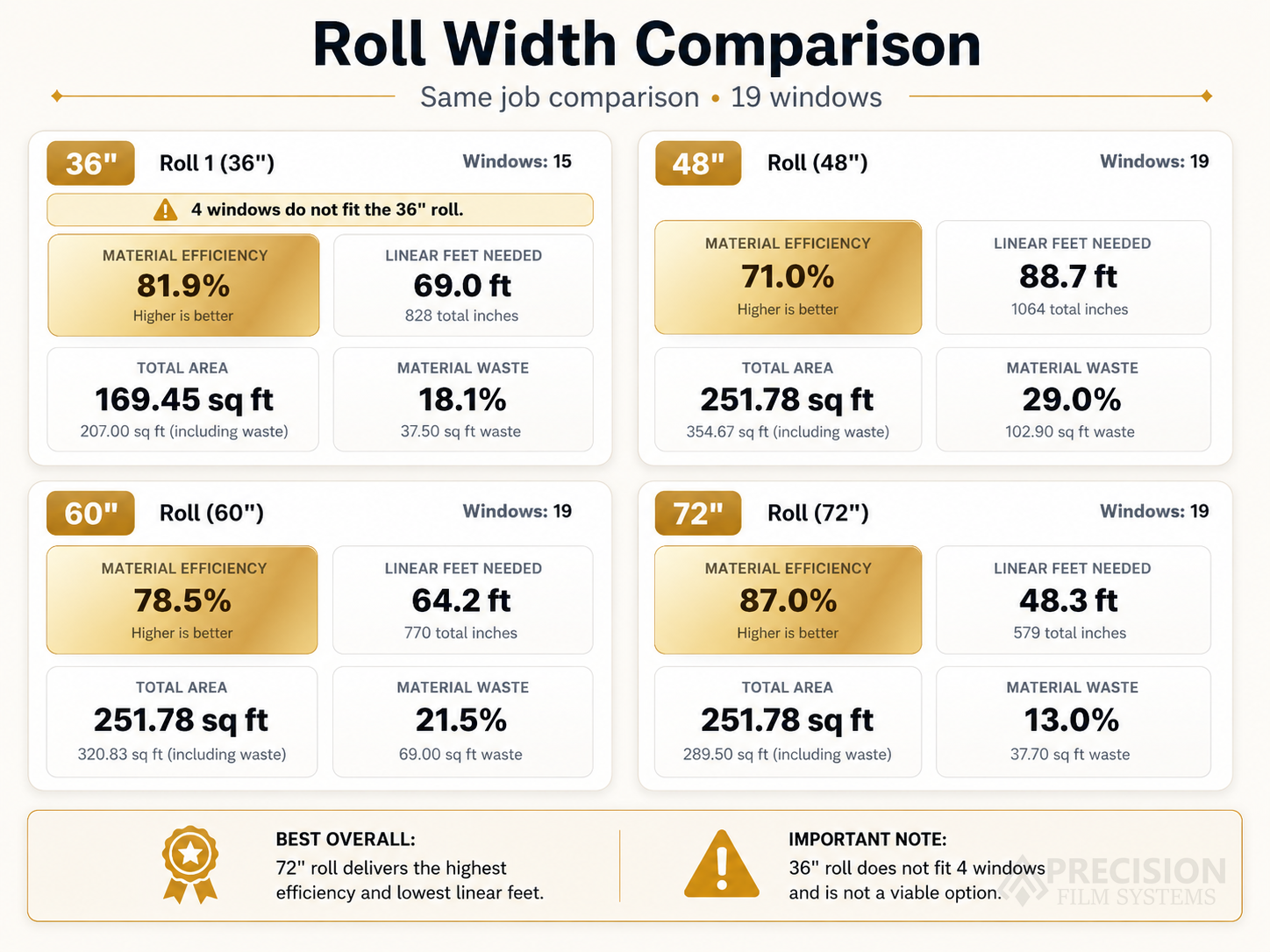
The following comparison uses one 19-window flat-glass job with 251.78 square feet of measured glass. The same pane list is tested against 36-, 48-, 60-, and 72-inch rolls.
The 36-inch roll does not fit every pane. It covers only 15 of the 19 windows, so it cannot serve as a single-roll option for the full job.
| Roll option | Windows covered | Linear feet needed | Material efficiency | Material waste | Planning note |
|---|---|---|---|---|---|
| 36-inch roll | 15 of 19 | 69.0 ft. | 81.9% | 18.1% | Four windows do not fit this width |
| 48-inch roll | 19 of 19 | 88.7 ft. | 71.0% | 29.0% | Fits the job but uses the most length and creates the most waste in this comparison |
| 60-inch roll | 19 of 19 | 64.2 ft. | 78.5% | 21.5% | Improves on the 48-inch result but is not the strongest layout here |
| 72-inch roll | 19 of 19 | 48.3 ft. | 87.0% | 13.0% | Best visible layout result in this comparison |
For this job, the 72-inch roll covers every window, uses the fewest linear feet, and produces the lowest cut-layout waste of the viable single-roll options.
That does not mean a 72-inch roll is always best. It means this particular pane list uses the extra width well. Another residential or commercial job can produce a different answer.
Do Not Compare Linear Feet Without Roll Width
Linear feet only makes sense when it stays connected to roll width.
Thirty linear feet of 72-inch film is not the same amount of material as 30 linear feet of 36-inch film. The length is the same, but the material area, purchase cost, handling, and potential remainder are different.
A useful comparison keeps these numbers together:
| Number | What it tells the shop |
|---|---|
| Roll width | Which material width is being evaluated |
| Linear feet used | How much roll length the planned layout consumes |
| Order length | How much film must actually be bought or allocated |
| Cut-layout waste | Material left unused within the planned layout |
| Remainder | Film left on the ordered or pulled roll after the job |
| Usable inventory | Remainder that is protected, tracked, and realistic to use later |
The lowest linear-foot option may still cost more if it requires a much wider roll. A layout that uses slightly more length may be the better purchase when the narrower film costs less and fills the width cleanly.
Order Length Can Change the Decision
The calculated film used and the amount that can be ordered are not always the same.
Suppliers may sell film in set increments or require a minimum order. A shop may also add material for trimming, handling, difficult access, replacement pieces, or product availability.
For example, one layout may use 38 feet and another may use 43 feet. If both require a 50-foot purchase, the five-foot difference does not decide the order by itself. The shop still needs to compare:
- the cost of each roll width;
- the layout waste;
- the film remaining after the job;
- whether that remainder is likely to be used; and
- whether the roll is practical to handle.
The cut layout supports the buying decision. It does not replace the rest of it.
Waste and Remainder Are Different
Cut-layout waste is the unused material created by the way the pieces fit within the planned layout.
Remainder is the film left on the roll after the planned length is used.
Those two numbers should not be blended together. A job can have a clean, low-waste cut layout and still leave a substantial remainder because the film had to be ordered in a larger increment. That remainder may be useful on another job if the shop can identify, protect, and track it.
An awkward strip left beside every cut is different. Even though it is technically film, it may be too narrow or inconvenient to become realistic inventory.
Treating every leftover piece as valuable can make a material plan look better than it is. Treating every remainder as waste can hide material that the shop could use later.
Check the Practical Side Before Choosing the Roll
A layout can work mathematically and still be a poor choice in the shop or field.
Before committing to the roll, check:
| Check | Why it matters |
|---|---|
| Is the film available in that width? | A strong layout does not help if the product cannot be ordered |
| Can the pieces be rotated? | Film direction, patterns, or job requirements may limit orientation |
| Are seams acceptable? | Larger panes may rule out narrower widths |
| Is the roll practical to handle? | Wider film can affect setup, cutting, transport, and installation |
| What order increment is required? | Used length and purchased length may be different |
| Is the remainder realistically usable? | Leftover film only has value when it can be stored and used |
| Are film types separated? | Each product needs its own roll-size decision |
| Has film-to-glass compatibility been reviewed? | Material planning does not replace manufacturer guidance |
This review does not need to make every job complicated. It keeps the roll decision connected to how the work will actually be ordered, cut, and installed.
The Quickest Manual Method—and Its Limit
For a simple job, an installer can sketch the roll width and place the planned cut sizes across it. Start with any panes that only fit the wider options, then see whether the smaller repeated pieces fit beside each other or within the remaining width.
Repeat that process for every roll width being considered and calculate the total length required.
That method works, but it becomes slower and easier to misread as the job gains:
- more unique pane sizes;
- higher quantities;
- multiple rooms or elevations;
- different film types;
- rotation choices; or
- partial rolls already in the shop.
The problem is not that manual planning is impossible. It is that comparing several valid layouts can take longer than expected, especially when the installer also needs to calculate linear feet and waste.
How Precision Film Systems Fits Into the Decision
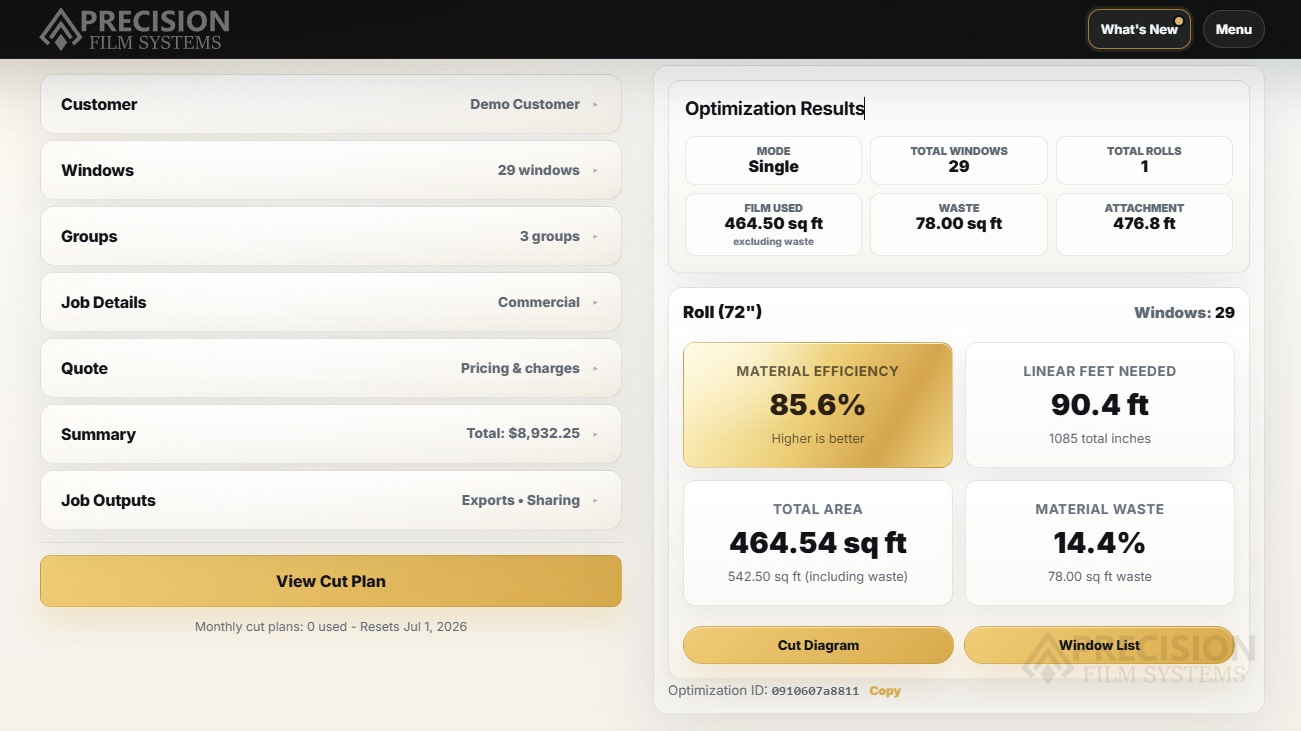
Precision Film Systems is built for the comparison between measurements and the material order.
Enter the pane sizes and quantities, then compare the job across the standard roll widths available for the film. Precision Film Systems shows how the options differ by pane fit, efficiency, linear feet, waste, and cut layout.
It does not remove the installer’s judgment. Availability, film cost, order increments, handling, compatibility, and the possible value of leftover film still belong in the final decision.
The purpose is to make the material tradeoffs visible before the film is ordered or pulled.
For residential window tint, that can mean checking mixed window sizes and large door glass without working through every layout by hand. For commercial window film, it can mean seeing how repeated panes affect the roll through the full elevation. Both are part of the same flat-glass planning workflow.
Choosing a Window Film Roll Size
What size roll do I need for a residential window tint job?
There is no single roll size that is best for every residential job. Compare the pane sizes and quantities against the roll widths available for the selected film. The best option should fit the necessary panes while producing a practical balance of linear feet, waste, order length, cost, and handling.
What is the quickest way to choose a window film roll size?
The quickest dependable method is to enter the planned pane sizes and quantities into a cut planner that compares the available roll widths. For a very small job, the comparison can be sketched manually, but the full pane list still needs to be checked rather than choosing from the largest window alone.
Is choosing a roll size different for residential and commercial window film?
The planning method is the same. Both residential and commercial work use individual pane sizes, quantities, film types, roll widths, orientation, linear feet, and waste. Residential jobs often contain more mixed sizes, while commercial jobs may contain larger quantities of repeated panes.
Should I use the smallest roll that fits the largest window?
Not automatically. That roll may be the best choice, but the rest of the panes may fit more efficiently on another width. Test the full job before deciding.
Is a 72-inch roll always more efficient?
No. A 72-inch roll can reduce required pulls and linear feet when the layout uses the extra width. It can also create more unused material, cost more, and be harder to handle when the panes do not fit it efficiently.
Does the lowest linear footage mean the best roll?
Not always. Linear feet must be considered with roll width, material cost, order increments, layout waste, handling, and usable remainder. Fewer feet of a wider roll may still be the more expensive or less practical purchase.
Is square footage enough to calculate how much window film I need?
No. Square footage shows the measured glass area. It does not show how the pieces fit on a roll, how many pulls are required, how much layout waste is created, or what order length is needed.
What should I check before ordering film?
Confirm pane sizes and quantities, film type, available roll widths, orientation rules, linear feet, cut-layout waste, order length, handling requirements, usable remainder, and film-to-glass compatibility before placing the order.
Compare roll widths before ordering film.
Enter the window sizes, compare standard roll options, and see the linear feet, efficiency, waste, and cut layout for the job.