
Some shops keep commonly used films on hand so an approved job can move without waiting on another material order. A shop may keep one preferred width of a film, or it may have several widths of the same product ready to go.
Either way, having the film in stock does not answer the whole material question.
Before pulling a roll, Single Roll in Precision Film Systems shows how the job lays out across the standard widths so the shop can see which stocked option uses the material best—or whether ordering another width is worth considering.
If you stock more than one width, compare what you already have
A shop that keeps several widths of the same film may not need to order anything for the job.
Maybe 48-inch, 60-inch, and 72-inch rolls are all sitting in stock. Once the windows are entered, Single Roll shows the results for those standard widths together.
The shop can look at the rolls it already owns and see which one gives the better layout before anything gets pulled.
If the 60-inch and 72-inch rolls both handle every window, but the 72-inch option uses noticeably less film, there is no reason to choose the 60-inch roll simply because it was the first one somebody reached for.
The material is already there either way. The comparison helps decide which stocked roll should actually go to the job.
One stocked width creates a different decision
Other shops may keep only one width of a particular film.
If the customer approves the job and that film is already on the truck or back at the shop, using it may be the quickest option. Sometimes it will also be a good material fit.
Other times the comparison may show enough additional waste or roll length that ordering another width deserves a look.
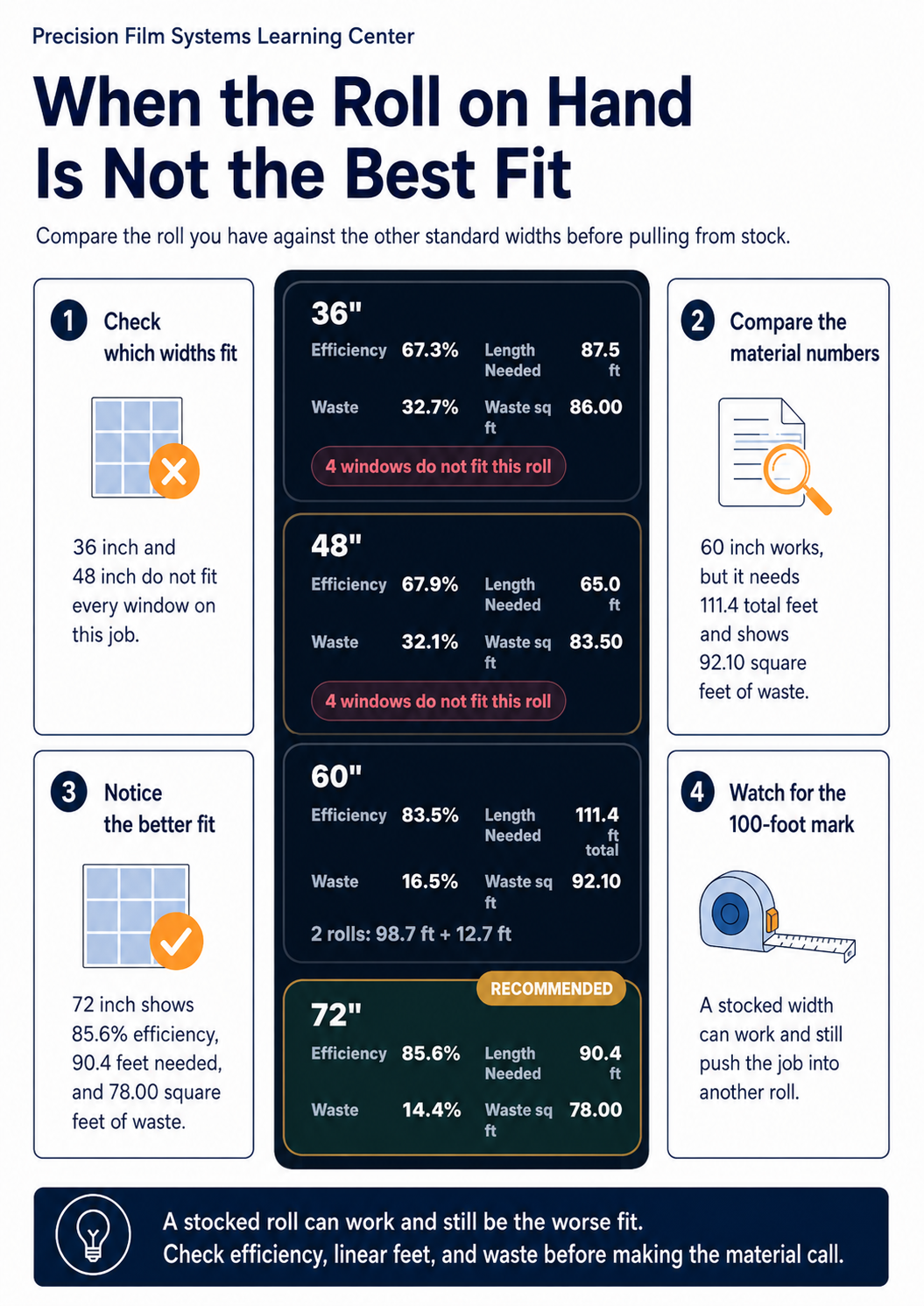
Single Roll shows the efficiency, linear feet, waste percentage, and wasted square footage for the standard widths that can handle the job. It also shows when a width cannot fit every window or when the plan requires more than one roll.
That lets the shop compare the convenience of using stock against the material difference before deciding.
The waste number can turn into real money
Take the example shown in Precision Film Systems.
The 60-inch option uses 111.4 feet and shows 92.10 square feet of waste. The plan also crosses 100 feet, so it requires a second roll.
The 72-inch option uses 90.4 feet and shows 78.00 square feet of waste.
That is a difference of 14.1 square feet.
If the film costs the shop $5 per square foot, that difference is $70.50 in material. At $6 per square foot, it is $84.60.
On one job, the shop may decide the convenience of using the stocked width is still worth more than that difference.
But a shop that makes the same kind of choice several times a month can spend a meaningful amount of money on film that never reaches a window.
Four similar jobs would put that 14.1-square-foot difference at roughly $282 to $338 in material cost.
The most efficient roll does not automatically win
The comparison is there to help with the decision, not make it for the shop.
If two stocked widths are close, there may be no practical reason to choose one over the other based on a small efficiency difference.
The same applies when the better-performing width would have to be ordered. Freight, timing, the value of getting the job installed immediately, and what will be left after the job can all affect the call.
Sometimes the stocked roll is still the better business decision even if another width shows slightly better material numbers.
The useful part is knowing what the difference actually is before committing the film.
A roll can fit and still be a poor fit
Window dimensions can make some stock widths expensive to use even when every piece technically fits.
If the shop has a 48-inch roll and the job has a large number of 31 x 27 windows, another width may allow those pieces to sit together across the roll much better.
The 48-inch roll is usable. That does not mean it is the roll the shop should automatically pull.
Single Roll puts the standard-width results together so the layout can answer that question quickly.
Crossing 100 feet deserves another look
Roll count can change the material decision just as quickly as the waste percentage.
A stocked width might need 105 or 110 feet while another option finishes the job inside a single 100-foot roll.
If the shop already stocks both widths, the choice may be easy once that is visible.
If the better width is not in stock, the shop can decide whether ordering it makes more sense than opening another full roll to finish the remainder of the job.
With expensive film, that second-roll requirement can become a much bigger consideration than a small percentage difference on the results screen.
Leftovers may have value on the next job
Sometimes the best material choice depends on what else is coming up.
If another job using the same film is already scheduled, a remainder from the first job may fit the second one well enough to affect which width the shop wants to use.
Once a full roll becomes a partial, the planning question changes.
Using Film on Hand to Plan Around Partial Rolls shows how those remaining widths and lengths can be brought into the next cut plan instead of being treated like another full roll.
Check the stock before you pull it
Keeping film in stock is supposed to make jobs easier to move.
Precision Film Systems does not change that. It gives the shop a quick way to see whether the width it is about to pull is also a good fit for the windows.
If several widths are already in stock, Single Roll can show which one uses the material better.
If only one width is available, the comparison shows what using that convenience may cost compared with ordering another option.
Sometimes the roll already sitting there is exactly the one to use.
Sometimes a different stocked width saves a noticeable amount of film.
And sometimes the numbers make another material order worth considering before the first cut is made.
Frequently asked questions
What if I already stock several widths of the same film?
Single Roll shows the standard widths together, so you can compare the stocked options and see which one fits the job better before pulling a roll.
What should I compare between roll widths?
Look at whether the width fits every window, then compare efficiency, linear feet, wasted square footage, and whether the plan stays within one roll.
Does the most efficient width always make the most financial sense?
No. The shop may already own another width, need to install the job quickly, or have a useful plan for the remainder. The material comparison is one part of the decision.
Why pay attention to wasted square footage?
Wasted square footage makes it easier to put an actual material cost behind the difference between two layouts. On higher-cost films, even a modest difference can add up quickly.
When should I use Film on Hand instead?
Film on Hand is for planning around partial rolls or custom amounts of film already available. Single Roll is the better place to compare full standard roll widths, including widths the shop already keeps in stock.